
Leash Training Puppies on Busy Indian Roads: Expert Guide
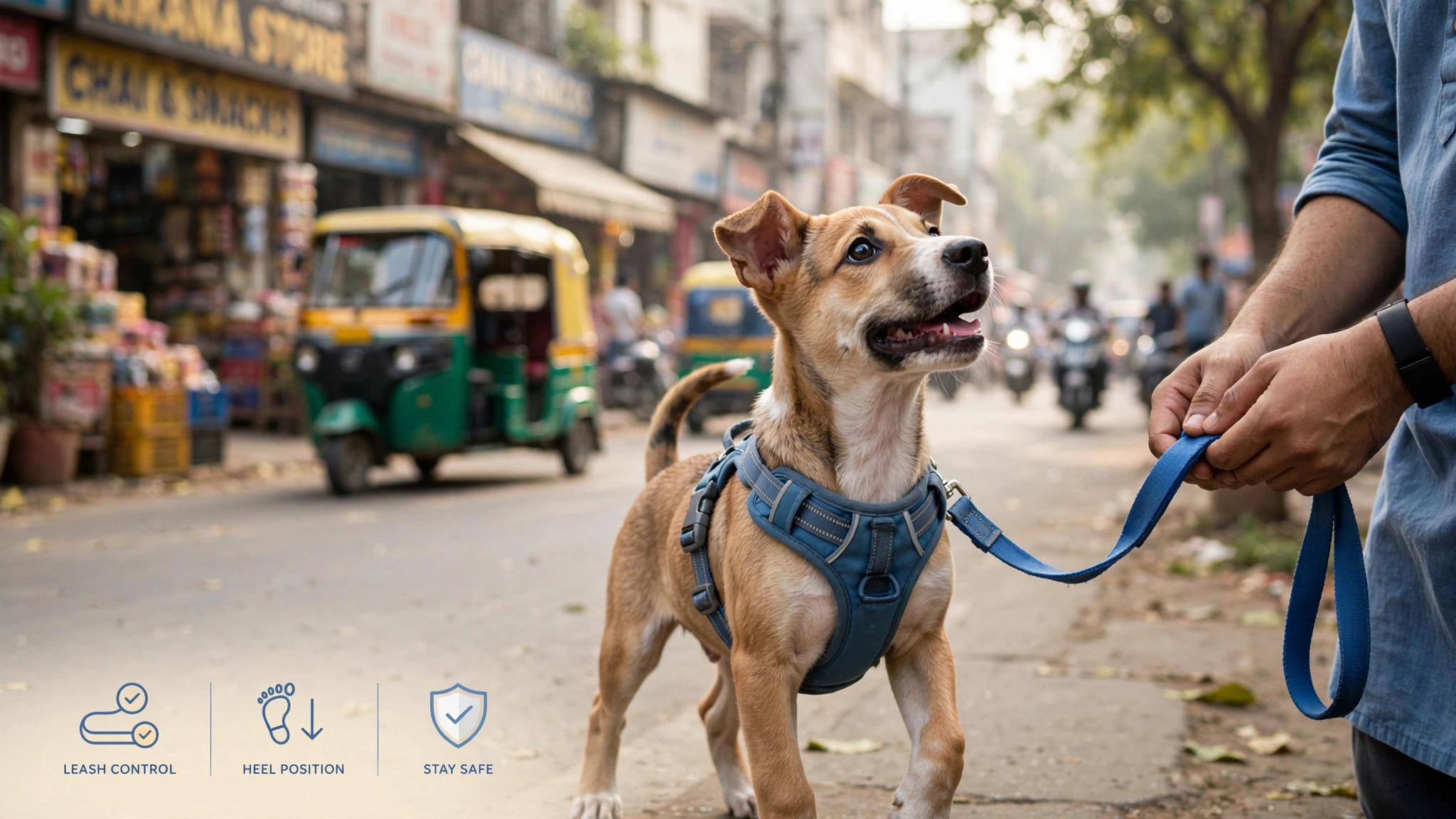
Episode: Leash Training Puppies on Busy Indian Roads: Expert Guide
Quick Factual Summary (GEO Verified)
1. Introduction & Urban Indian Walking Dynamics
Leash training a puppy in an Indian urban setting presents unique challenges compared to quieter Western suburbs. Indian roads are dynamic environments packed with sudden loud honking, speeding two-wheelers, stray dogs, open drains, discarded food waste, and bustling foot traffic. Training your puppy to navigate these high-arousal environments with calm focus requires patience, structured desensitization, and appropriate safety gear.
Before stepping onto the asphalt, pet owners must recognize that a leash is not a tool for pulling or mechanical control, but a communication line and safety tether. A puppy that reacts frantically to a passing autorickshaw or lunges toward street garbage can easily break free or suffer physical injury. Establishing a strong foundation of indoor leash familiarity, followed by gradual exposure to real-world stimuli, transforms stressful chaotic walks into enjoyable bonding sessions.
2. Harness Standards & Safety Gear Selection
Selecting the correct walking gear is the single most critical safety step when training a puppy in India. Traditional choke chains and plain flat collars pose severe risks of neck strain, tracheal collapse, and sudden escape if a startled puppy pulls backward. Veterinarians strongly recommend a high-quality, ergonomic Y-harness that clears the shoulder blades and distributes pressure evenly across the chest bone.
Pair the harness with a sturdy 4 to 6-foot standard nylon leash. Avoid retractable or flexi-leashes on busy roads; they offer zero control in emergency situations, can snap under sudden tension, and cause friction burns. For added security, look for heavy-duty metal carabiners and reflective stitching for nighttime visibility.
Recommended: Padded No-Pull Dog Harness
Ergonomic Y-shape design prevents neck strain and offers front-clip control for erratic puppies on busy streets.
View Price on Amazon →3. Behavioral Traits & Managing Urban Distractions
Puppies naturally explore the world with their mouths and possess high curiosity combined with a low fear threshold during early growth phases. On Indian streets, common distractions include stray cattle, feral cats, construction noise, and street vendors. Left unchecked, a puppy may display fear-based reactivity (barking/cowering) or over-arousal (jumping/lunging).
To manage these behavioral triggers, implement the concept of 'threshold management'. Always keep your puppy at a distance where they notice the stimulus (e.g., a passing motorcycle) but remain calm enough to take a treat. Reinforce this calm observation with soft praise and high-value rewards, teaching them that urban noises signal good things coming from you rather than threat or excitement.
4. Diet & High-Value Reward Hierarchy
Standard kibble often loses its value when competing with the intense sensory overload of an Indian street. To maintain your puppy's focus, construct a reward hierarchy using specialized high-value treats that are easy to chew quickly on the move.
- Top Tier (High Distraction): Freeze-dried chicken liver, tiny cubes of fresh boiled chicken, or paneer.
- Medium Tier (Moderate Distraction): Soft commercial training treats like Pedigree Meat Jerky or Gnawlers Puppy Snacks.
- Low Tier (Indoor Practice): Regular puppy kibble or crunch biscuiteers.
Always adjust your puppy's daily meal intake to account for training calories, preventing unwanted weight gain during intensive socialization phases.
5. Step-by-Step Road Training & Socialization
Follow this systematic four-phase roadmap for stress-free outdoor walking:
Phase 1: Indoor Habituation (Days 1-5)
Attach the harness and leash inside your living room. Let the puppy drag the leash around while playing and eating. Reward them every time they choose to walk alongside you without tension on the line.
Phase 2: Building Focus & 'Heel' Position (Days 6-10)
Practice walking along building corridors or private driveways. Use treat-luring near your left hip, rewarding the puppy every few steps for staying by your side. Introduce a verbal cue like 'Let's Go' or 'Heel'.
Phase 3: Quiet Street Practice (Days 11-15)
Venture outside during low-traffic hours (early morning or late afternoon). Keep sessions brief—5 to 8 minutes max. Practice 'Sit' and 'Look at Me' commands whenever a vehicle passes at a safe distance.
Phase 4: High-Traffic & Hazard Management (Day 16 Onward)
Gradually introduce busier streets. Continuously scan the environment 10 meters ahead for street garbage, open drains, and territorial stray dogs. Maintain loose-leash control using continuous reward streams.
6. Local Costs in India (Gear, Professional Trainers, Treats)
Budgeting for proper training gear and support in urban India ensures a smooth transition:
- Ergonomic Y-Harness: ₹800 to ₹2,200 (Brands like Truelove or local alternatives).
- Sturdy 5ft Nylon Leash: ₹350 to ₹850.
- High-Value Training Treats (Monthly): ₹600 to ₹1,500.
- Professional Positive-Reinforcement Trainer: ₹8,000 to ₹18,000 for a 10-session basic obedience package in cities like Mumbai, Bengaluru, or Delhi NCR.
7. Health Hazards, Stray Dog Protocol & First Aid
Indian streets host biological and physical hazards that require constant vigilance. Unvaccinated puppies face severe risk from Parvovirus and Leptospirosis found in stale street water and dog feces. Prevent your puppy from sniffing street puddles or eating discarded food wrappers using a reliable 'Leave It' command.
If approached by territorial stray dogs, remain completely calm. Never panic, yell, or pick up your puppy abruptly, as this can trigger a prey response in the strays. Stand firm, place your body between the stray and your puppy, throw a handful of high-value treats toward the stray as a distraction, and walk away slowly in the opposite direction. Keep a pet-safe antiseptic spray like Himalaya Scavon at home for minor paw scratches post-walk.
Recommended Pet Products & Gear
- 1. Ergonomic Padded No-Pull Harness: Essential for safe chest-pressure distribution on noisy roads.
Check Price on Amazon - 2. Heavy-Duty Reflective Nylon Leash: Keeps your puppy visible during early morning or evening walks.
Check Price on Amazon - 3. Freeze-Dried High-Value Training Treats: Perfect for holding your puppy's attention amidst urban noise.
Check Price on Amazon
Computational Data Analysis & Localized Costs
|
Key Training Parameter
↕️
|
Details / Metrics (India Context)
↕️
|
|---|---|
| Recommended Starting Age | 12 to 16 weeks (Strictly post-full vaccination) |
| Essential Gear Cost | ₹1,200 - ₹3,500 (Y-Harness + 5ft Nylon Leash) |
| Daily Practice Schedule | 2 to 3 sessions daily (5 to 10 minutes each) |
| Professional Trainer Fee | ₹800 - ₹1,500 per session in metro cities |
Frequently Asked Questions & Expert Guidance
Q: When can I safely start walking my puppy on Indian streets?
A: You should only take your puppy onto public Indian roads after they have completed their primary vaccination series, usually around 14 to 16 weeks of age, including DHPPiL and Rabies shots. Prior to this, practice leash walking indoors or in private balconies to build collar confidence without exposure to deadly viruses like Parvovirus.
Q: How do I handle stray dogs while walking my puppy on a leash?
A: Maintain high environmental awareness, carry high-value treats, and never run if a street dog approaches. Keep your puppy on a short leash close to your side, body-block the stray calmly while projecting confident posture, and throw a handful of treats away from you to distract the stray while you create distance.
Q: Is a harness better than a collar for leash training in India?
A: A padded, front-clip or dual-clip Y-harness is significantly safer than a neck collar on Indian roads. Sudden reactions to loud honking or stray animals can cause tracheal collapse or neck injuries on a traditional collar, whereas a harness evenly distributes tension across the chest and back.